


Featured News
(NSGH) “When the nation prospers or declines, every ordinary citizen bears responsibility.” This ancient Chinese maxim has become one of the most enduring principles in East Asian thought. Though concise, it conveys a profound truth: no community can endure if it is built upon the indifference of the many. Whenever the common good is threatened, no one has the right to consider himself merely an observer.
This principle does not belong exclusively to the sphere of politics or civil society. It also finds a meaningful resonance within the life of the Church. The Church is not an institution sustained solely by bishops, priests, or religious. She is the People of God, the communion of all who have been incorporated into Christ through the Sacrament of Baptism. Every baptized person therefore shares, according to his or her vocation, in the life and mission of the Church.
For this reason, when the Church experiences trials, challenges, or moments of crisis, the faithful cannot simply say, “That is the responsibility of the bishops or the clergy.” Such an attitude risks distancing the lay faithful from the very household to which they belong. To love the Church is not merely to receive her spiritual gifts, but also to recognize one’s responsibility for her well-being and mission.
The digital age has transformed the way Catholics encounter the life of the Church. Previous generations often learned of ecclesial events only through local communities or personal testimony. Today, information crosses continents within moments, allowing the faithful to witness both the joys and the wounds of the Church in real time. This unprecedented access to information also demands greater maturity, discernment, and fidelity to the truth.
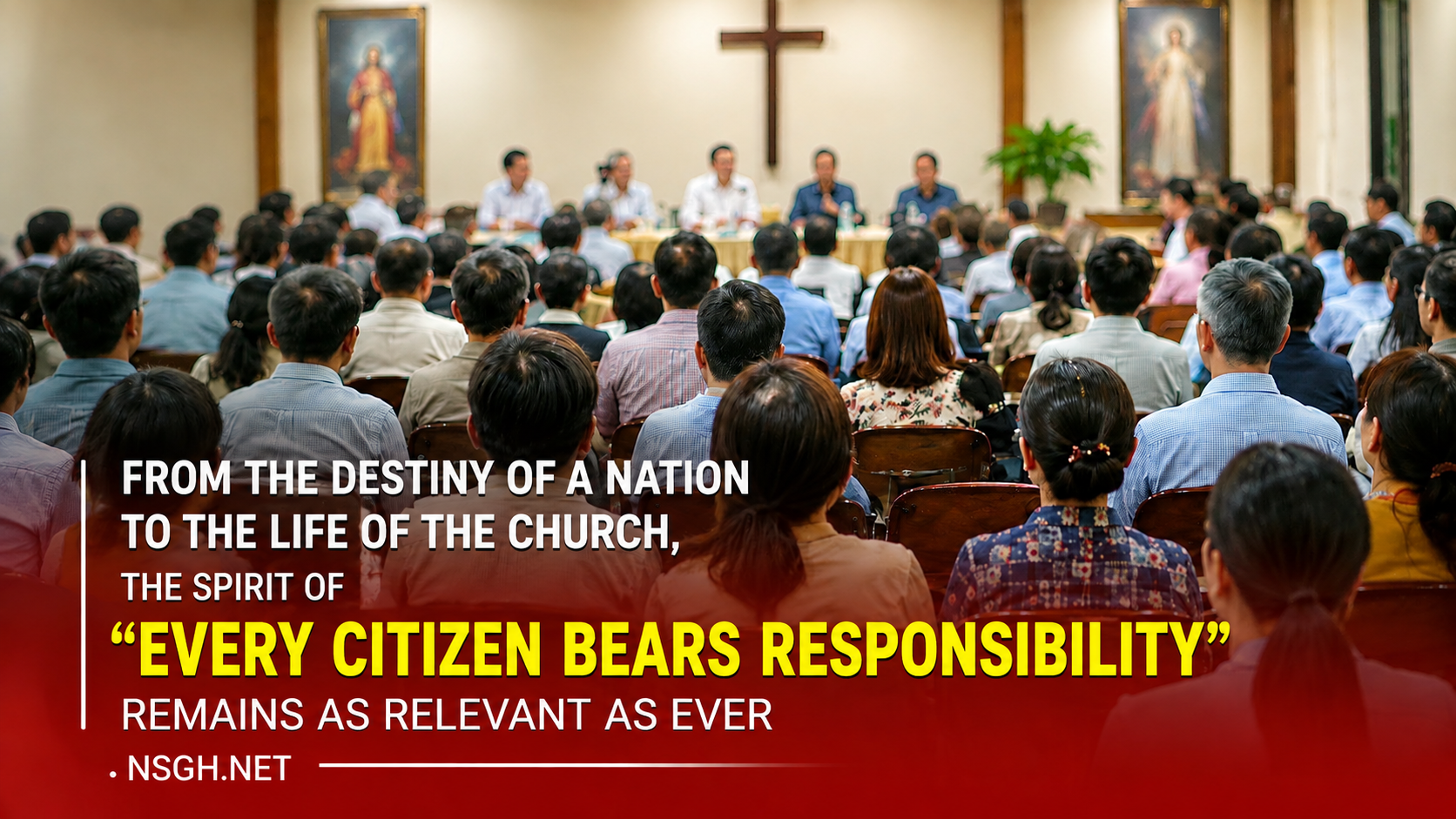
In this context, the spirit of “every citizen bears responsibility” should not be interpreted as a call to confrontation or opposition. Rather, it is an invitation for every member of the faithful to recognize that he or she also bears responsibility for safeguarding the Church’s communion, her witness to the truth, and her holiness. Such responsibility is exercised not through hostility or division, but through charity, prudence, and a sincere desire for the good of the entire Body of Christ.
A Church Cannot Flourish on the Silence of the Faithful
The history of the Church has never been written by popes, bishops, and priests alone. Every period of renewal has also borne the unmistakable imprint of faithful men and women who embraced their baptismal vocation with courage and responsibility. Throughout centuries of persecution, internal crises, and cultural upheaval, it has been the collaboration of the entire People of God that has enabled the Church to remain steadfast in her mission.
A truly mature ecclesial community is one in which every member understands that he or she is not merely a beneficiary of the Church’s life, but also an active participant in preserving and strengthening it.
Silence can indeed be a virtue. It allows room for prayer, attentive listening, humility, and restraint from rash judgment. Yet silence may also become a failure of responsibility when it is rooted in indifference, fear, or the desire to leave every burden to others. In such circumstances, silence ceases to be an expression of wisdom and instead becomes a form of disengagement from the common good of the Church.
The Church does not call the lay faithful to become judges of others, nor does she encourage them to deepen divisions within the ecclesial community. Neither should every difficulty be transformed into a trial before the court of public opinion. Rather, the faithful are called to spiritual and human maturity: to seek the truth, to exercise sound judgment, and to make use of the legitimate means provided by the Church to express their concerns whenever the good of the ecclesial community so requires.
Such participation is not an act against the Church. On the contrary, it is an expression of love for the Church and a genuine contribution to her continual renewal and fidelity to the mission entrusted to her by Christ.
The Strength of the Church Comes Not Only from Her Pastors but Also from the Responsibility of the Lay Faithful
Christ entrusted the Apostles and their successors with the mission of shepherding His flock. At the same time, He gathered all believers into one People of God, united in faith and called to journey together toward the Kingdom. Consequently, the strength of the Church has never depended solely upon the wisdom of her pastors or the administrative abilities of her hierarchy. It is also nourished by the faith, generosity, and sense of responsibility of every member of the faithful. A vibrant Church is not the work of a privileged few but the fruit of the communion and active participation of the whole ecclesial community.
The lay faithful do not belong to the Church merely as recipients of pastoral care. Through Baptism, they are called to become active participants in the Church’s life and mission, sharing not only in her joys but also in her concerns, her struggles, and her hopes. This responsibility neither diminishes the unique ministry entrusted to the ordained nor challenges the hierarchical structure established by Christ. Rather, it affirms that every baptized person bears a genuine responsibility for the unity, vitality, and future of the Church.
The history of Christianity offers abundant testimony to the indispensable role of ordinary believers. From the martyrs of the early Church to holy men and women who lived their vocation in the midst of ordinary society, the faithful have continually strengthened the Church through their fidelity to the Gospel, their generosity, and their perseverance. Many were neither ordained ministers nor members of religious communities, yet their witness became a source of renewal for the entire Church. Every act of faith, however humble, becomes a living stone contributing to the building up of the household of God.
This sense of responsibility becomes even more essential when the Church faces difficult moments or the challenges of a rapidly changing world. The lay faithful are not called to replace the ministry of bishops or priests, but neither are they invited to remain passive observers. By living lives of integrity, by speaking with charity and truth, and by making use of the legitimate means that the Church provides for expressing their concerns for the common good, they help foster a Church that is ever more transparent, united, and faithful to Christ.
A strong Church is one in which every vocation is lived faithfully. Pastors guide the flock entrusted to their care, while the lay faithful bring the light of the Gospel into families, workplaces, parishes, and society at large. When these complementary responsibilities meet in genuine communion and love for the Church, the People of God are strengthened to withstand the trials of every age and to continue proclaiming the Gospel with renewed credibility and hope.
The Digital Age Does Not Allow the Lay Faithful to Remain Mere Spectators of the Church’s Life
Never before has the life of the Church been so profoundly influenced by the power of modern communications. Within minutes, information can reach millions of people; within moments, an event taking place in a single local Church can become known throughout the world.
The digital age has opened unprecedented opportunities for the faithful to remain informed about the life and mission of the Church. At the same time, it has placed upon every Catholic a greater moral responsibility: the responsibility to seek and defend the truth, and to use one’s voice for the authentic good of the Church.
In previous generations, geographical distance often limited the spread of information, and many events remained known only within a local community. Today, however, nearly everything unfolds before the eyes of a global audience. This reality calls the lay faithful not only to receive information but also to verify it carefully, to exercise prudent discernment, and to respond with the wisdom that flows from faith.
An unverified claim shared online can damage ecclesial communion. A hasty judgment or an extreme reaction may deepen wounds that already exist within the Church. Conversely, a voice marked by prudence, charity, and fidelity to the truth can help preserve the Church’s credibility and strengthen the bonds of communion among the faithful.
In this environment, Catholics can no longer regard themselves as detached spectators. The Church is not a stage upon which a few perform while the rest simply watch. Every baptized believer is a living member of the People of God and therefore shares responsibility for the life and mission of the ecclesial community.
This responsibility is not exercised through curiosity, sensationalism, or superficial judgment. Rather, it is lived through an upright conscience, a sincere love for the Church, and the responsible use of the legitimate means that the Church provides whenever the faithful deem it necessary to express their views for the common good. Such participation must always be guided by truth, charity, and respect for ecclesial communion.
History repeatedly demonstrates that every crisis eventually passes. What endures is the manner in which God’s people choose to confront that crisis. A community that seeks the truth, respects justice, and willingly shares responsibility emerges stronger after adversity. By contrast, widespread indifference and the refusal to assume responsibility only prolong wounds and gradually erode confidence within the ecclesial community.
For this reason, the spirit expressed in the maxim, “When the nation prospers or declines, every ordinary citizen bears responsibility,” extends beyond civic life. For Christians, it also serves as a reminder that every member of the faithful bears responsibility for the well-being of the Church, our common spiritual home. In the digital age, every word should be illuminated by truth, every action guided by charity, and every decision inspired by a genuine desire to build up, rather than weaken, the Body of Christ.
Such responsibility is not merely a moral obligation. It is a sign of mature faith, authentic ecclesial communion, and a sincere love for the Church founded by Jesus Christ. By embracing this vocation with humility and fidelity, the lay faithful participate actively in the Church’s mission of proclaiming the Gospel and bearing witness to Christ in the contemporary world.
Thien Phuoc
References
- Code of Canon Law (1983), Canons 208; 212 §§2–3; 225.
- Second Vatican Council, Dogmatic Constitution on the Church Lumen Gentium, nos. 30–38.
- Second Vatican Council, Decree on the Apostolate of the Laity Apostolicam Actuositatem.
- Saint John Paul II, Post-Synodal Apostolic Exhortation Christifideles Laici (On the Vocation and Mission of the Lay Faithful in the Church and in the World, 1988).
- Catechism of the Catholic Church, nos. 897–913.
- Pope Francis, Apostolic Exhortation Evangelii Gaudium (The Joy of the Gospel, 2013).
- International Theological Commission, Synodality in the Life and Mission of the Church (2018).
RELATED POSTS
- 01 More Than Half a Century of FABC: Time for a Transparent Report to the People of God
- 02 A $0.20 Cake and a Catholic Student’s Dream of Higher Education
- 03 Cardinal Luis Antonio G. Tagle Arrives in Vietnam to Preside Over the Beatification of Father Francis …
- 04 Millions Turn Their Hearts Toward Tac Say as Father Truong Buu Diep Is Declared Blessed
- 05 Pilgrimage Centers: Let Them Be More Than Brick and Concrete